
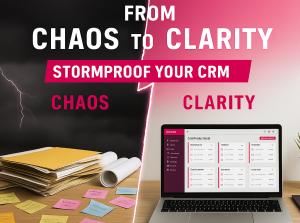
You bought the software. You set it up. But leads are still slipping, your team isn’t using it, and nothing feels organized.
So what’s actually going on?
The Frustration No One Talks About
Most roofing contractors do not have a CRM problem. At least not the way they think.
You did what everyone tells you to do. You researched platforms, picked something solid, and invested time getting it set up.
And yet nothing really changed.
Leads still fall through. Follow-ups are inconsistent. Your team works around the system instead of inside it. And you are left wondering if it was even worth it.
From conversations on the Roofing Success Podcast and what we see across the industry, this is extremely common.
The Truth: It Was Never About the CRM
Here is the part most people will not tell you.
The problem is not your CRM. It is the system behind it.
A CRM is just a tool. If there is no structure behind it, no clear process, no defined workflow, no accountability, it will not fix anything.
It simply organizes the chaos you already had.
“But I Picked the Right One…”
You probably did.
There are solid platforms out there, and each one can work depending on your business. If you are still evaluating options, this breakdown is worth a look: https://day41thrive.com/blog/choosing-right-roofing-crm
That article walks through tools like Zuper, JobNimbus, and Roofr and what they are best suited for.
But here is what most contractors miss.
Choosing the right CRM is only a small part of the equation. What actually matters is how it is built into your business.
What Is Actually Breaking Down
When you zoom out, the issue is usually not software. It is how the business operates around it.
There is no consistent sales process. Follow-up is not clearly owned. The pipeline does not reflect reality. The team does not trust the system, so they avoid it.
At that point, the CRM becomes a place where information sits, but nothing actually moves.
What a CRM Should Actually Do
When it is set up correctly, a CRM becomes the command center of the business.
Everyone knows what step comes next. Leads are tracked and followed up consistently. Sales, production, and admin stay aligned.
Instead of reacting all day, the business starts operating with structure.
Why Most Contractors Stay Stuck
A lot of companies try to solve this by switching platforms.
They assume a new CRM will fix the problem.
But without fixing the underlying system, the same issues show up again in a different interface.
That is why experienced operators focus less on the tool and more on the structure behind it.
How Day 41 Thrive Approaches It Differently
One company that has been leading this shift is Day 41 Thrive.
Instead of treating CRM as software, they treat it as the operational backbone of the business.
Their approach focuses on fixing the structure first, then building the CRM around it.
That is where their StormProof™ CRM Stack comes in.
They start by diagnosing what is actually happening inside your current CRM. This includes where leads are getting stuck, where deals are falling apart, and where the process breaks down.
From there, they clean up the data and rebuild the workflows so the system reflects how the business should run.
They also work directly with your team to ensure the system is actually used. Because even the best setup fails if no one adopts it.
What Changes When It Is Done Right
When a CRM is built the right way, the difference is noticeable quickly.
Your team starts using it. Follow-ups become consistent. Visibility improves. You are no longer chasing information to understand what is happening.
That is when businesses move out of reactive mode and into something scalable.
The Bottom Line
You did not make a bad decision.
You picked a good CRM.
But without the right system behind it, it was never going to solve the problem.
A CRM does not fix your business.
A system does.
Want to See What Is Actually Broken?
If your CRM feels clunky, underused, or out of sync with your business, it may be time to look at it differently.
Day 41 Thrive offers a CRM Storm Report that shows what is actually happening inside your system and where the real issues are.
Once you see the problem clearly, fixing it becomes much easier.