Most roofing companies are not struggling because they lack work ethic or effort. In fact, many are busier than ever, juggling crews, managing jobs, and trying to keep up with demand. On the surface, things look like they are working.
But underneath, a different story is playing out.
Growth feels inconsistent. Profit margins are tight. Every new challenge requires immediate attention, and long-term planning keeps getting pushed to the side. What many contractors are experiencing is not a lack of leads or opportunity. It is a lack of structure.
After more than 300 episodes of The Roofing Success Podcast, one pattern continues to stand out. The companies that grow consistently are not simply working harder. They are operating with better systems.
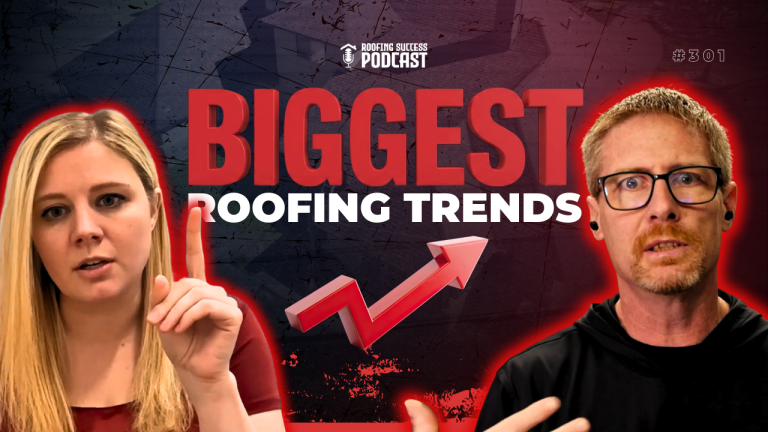
In Episode 301, Jim Ahlin sat down with Kaili Smith from JobNimbus to unpack what is actually driving performance in today’s roofing market and where most businesses are falling short.
Why So Many Roofing Businesses Feel Stuck
A common frustration among contractors is that they are doing everything right, yet still feel stuck. They are closing jobs, keeping crews busy, and maintaining a steady flow of work, but growth never quite accelerates the way they expect.
A major reason for this comes down to margins.
As Jim pointed out in the episode:
“At 30% margins, you’re stuck. There’s no way to grow.”
When margins are too tight, every decision becomes constrained. Marketing feels risky instead of strategic. Hiring feels like an expense instead of an investment. Even small improvements become difficult to justify because there is no room to absorb mistakes.
Kaili expanded on this idea by explaining that many contractors end up doing everything themselves, not because they want to, but because their business cannot support anything different.
“You’re basically doing it all yourself… and you can’t make the investments needed to grow.”
This creates a cycle where the business stays reactive. Instead of planning ahead, you are constantly responding to whatever problem shows up next, whether that is rising material costs, missed calls, or inconsistent lead flow.
The Difference Between Tools and Systems
One of the most important distinctions discussed in the episode is the difference between having tools and having a system.
Most roofing companies today are not short on tools. They have CRMs, estimating software, marketing vendors, and communication platforms. On paper, it seems like everything is in place.
However, those tools often operate independently.
“You can have a marketing tool, a sales tool, and a production tool… but if they don’t talk to each other, you’re losing money.”
This disconnect creates what Kaili described as a lack of a “loop.” Marketing generates leads, sales closes jobs, and production completes the work, but there is no clear connection between them. As a result, it becomes nearly impossible to understand what is actually driving performance.
“If you can’t see how marketing impacts your whole sales, production, and ROI… there’s no loop.”
Without that visibility, decisions are based on assumptions rather than data. You may continue investing in marketing that is not producing results, or overlook opportunities that could significantly improve your business.
This is exactly why the Peak Performance Report was created. It gives contractors a clearer view of what top-performing companies are doing across marketing, sales, production, and customer experience.
👉 Explore the Peak Performance insights here.
Where Revenue Is Actually Being Lost
When contractors think about growth, they often focus on generating more leads or improving close rates. While those areas are important, they are not always where the biggest opportunities exist.
In many cases, revenue is being lost in the gaps between processes.
These gaps often show up as:
- Delayed responses to incoming leads
- Unclear handoffs between marketing and sales
- Inconsistent follow-up with homeowners
- Limited visibility into the sales pipeline
- Poor communication throughout the project
Individually, these issues may seem small, but together they create friction at every stage of the customer journey. Over time, that friction leads to missed opportunities, lower conversion rates, and weaker customer relationships.
Why Communication Is the Biggest Lever for Growth
If there is one area that consistently separates high-performing roofing companies from the rest, it is communication.
Jim summarized it in a way that is difficult to ignore:
“If your customer is wondering, you are losing.”
When homeowners are unsure about what is happening, whether it is scheduling, project status, or next steps, trust begins to erode. Even if the work itself is done well, the overall experience suffers.
That uncertainty directly impacts reviews, referrals, and repeat business.
Interestingly, the solution is not simply hiring more staff or increasing manual effort. Instead, it comes down to building intentional communication processes that can be executed consistently.
Many contractors hesitate to adopt automation because they worry it will feel impersonal or robotic. However, this concern often overlooks what homeowners actually care about.
“They’re worried about sounding like a robot… but that’s not the point.”
The goal is not to perfectly replicate human conversation in every message. The goal is to eliminate confusion and keep the customer informed.
As Kaili explained:
“They don’t care if it’s automated. They just want to know what’s going on.”
The most effective companies take the time to define when and how communication should happen. They map out key touchpoints in the customer journey and use automation to ensure that nothing is missed.
In some cases, contractors even allow homeowners to choose their preferred level of communication, whether that is frequent updates or only major milestones. This level of intentionality creates a more personalized experience while still maintaining efficiency.
Why This Matters More Than Ever
The roofing industry is evolving quickly, and homeowner expectations are rising alongside it. Customers now expect faster responses, clearer communication, and a more seamless experience from start to finish.
At the same time, new tools and technologies are being introduced at a rapid pace. While these tools can be valuable, they only create an advantage when they are part of a cohesive system.
The companies that continue to grow will be the ones that connect their processes, improve visibility across their operations, and deliver consistent experiences to their customers.
Where JobNimbus Marketing Comes In
At a certain point, many contractors reach a plateau. They are working hard, generating leads, and closing jobs, but growth becomes difficult to sustain.
This is often not a reflection of effort, but of infrastructure.
JobNimbus Marketing was built to address this exact challenge. Rather than focusing solely on lead generation, it helps contractors build systems that connect marketing, sales, and operations into a single, cohesive process.
That includes improving response times, strengthening follow-up, enhancing customer communication, and providing clearer visibility into performance.
The goal is not just more activity, but better outcomes.
What This Means for Your Business
The difference between a good roofing company and a great one rarely comes down to effort alone. More often, it comes down to structure.
The companies that consistently grow are the ones that take the time to build systems, understand their numbers, and create an experience that customers trust.
Once that foundation is in place, everything else becomes easier to scale.